Best Turntable Setup for Small Apartments With Thin Floors
Why Thin Floors Are a Vinyl Problem
Turntables are mechanically fussy things. The stylus is tracing grooves that are, quite literally, a few microns wide, so anything that shakes the floor gets picked up and turned into noise: footsteps, bass thumping back up through the joists, even the turntable’s own motor humming along. In older buildings, or apartments built with hollow or “floating” subfloors, this gets worse fast. Low frequencies especially love to travel through wood framing, and they’ll march straight down into the apartment below yours.
So you end up with a two-sided headache. Your records sound worse than they should, full of rumble and the occasional skip, and your downstairs neighbor gets a muffled bass concert they never asked for.
Step 1: Choose the Right Turntable Placement
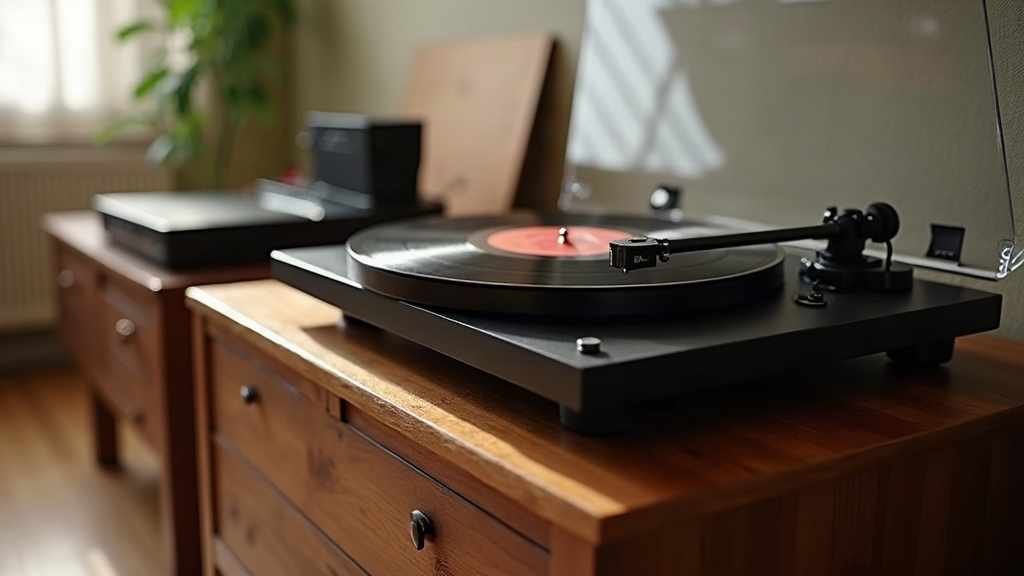
Don’t just plop the deck on a media console six inches from your speakers, and definitely not on some flimsy particleboard shelf that wobbles if you look at it wrong. Instead:
- Set it against a load-bearing wall, away from the center of any floating floor section. Load-bearing walls transmit far less vibration than open floor spans.
- Use a genuinely solid stand. A thick slab of solid wood, or a wall-mounted shelf bolted into studs, beats a $40 veneer cabinet every time.
- Give it distance from your speakers. Three feet of separation, minimum, cuts down acoustic feedback in a way that’s honestly kind of surprising until you try it.
Living in a studio with no room to separate things? A wall-mounted turntable shelf is probably the single most effective upgrade you can make. It takes the deck out of the floor’s vibration path entirely, which a stand sitting on the same floor simply can’t do.
Step 2: Isolation Platform (Non-Negotiable)
This is the step everyone tries to skip, and it’s the one they regret skipping. An isolation platform goes between the turntable and whatever it’s sitting on, soaking up vibration before it ever reaches the cartridge.
Solid budget options:
- Sorbothane feet or pads (roughly $20-30) work well on low-frequency rumble; they’re soft and dampen without adding any bounce.
- Cork-and-rubber composite mats are cheap and do a good job against footstep noise specifically.
- Spring or elastomer-footed platforms (Auralex, SVS, that sort of thing) perform the best of the bunch, but you’re looking at $60-150.
Here’s a cheap trick that actually works: a butcher-block cutting board with rubber feet screwed into the corners, set on top of a sorbothane pad, under the turntable. Total cost, under $40, and the difference is audible the first time you drop the needle.
Step 3: Speakers That Don’t Shake the Floor
Big floor-standing towers with 8-inch woofers are pretty much the worst thing you can own in a thin-floor apartment. Their bass couples directly into the floor structure, and that’s exactly the vibration path you’re trying to avoid.
Better options:
- Bookshelf speakers on dedicated stands (Elac Debut B6.2, KEF Q150, and similar) give you controlled, tighter bass with a lot less floor coupling.
- Active/powered monitors (Audioengine A5+, Kanto YU6) put the amplification inside the cabinet, so you get precise volume control, and many models include a bass roll-off switch that’s genuinely useful here.
- Only add a subwoofer if it has an adjustable crossover, and only if you isolate it properly with feet underneath. Otherwise, in a thin-floor unit, just leave the sub out of the equation. It’s rarely worth the trouble.
Put your speakers on stands, not directly on the floor, and slide isolation pads under the stands too. It’s a small step but it adds up.
Step 4: Volume and Timing Discipline
Even a dialed-in setup won’t erase sound transmission completely, so a few habits go a long way:
- Keep evening listening at a moderate level. Save the loud sessions for daytime, when there’s ambient noise to mask things anyway.
- Use a receiver with loudness or bass EQ to tame the low end without flattening the whole mix.
- Have headphones ready for late nights. A phono-stage headphone amp (something like a Schiit Mani paired with a headphone amp) gives you a full vinyl listening session with zero vibration hitting the floor.
Quick Setup Checklist
- ✅ Turntable on a solid stand against a load-bearing wall
- ✅ Isolation platform or sorbothane feet under the turntable
- ✅ Bookshelf speakers on isolated stands, not floor-standers
- ✅ Bass EQ or receiver rolloff dialed back
- ✅ Headphones on standby for quiet hours
Final Thoughts
Building a good vinyl setup in a small apartment isn’t about throwing more money at it. It’s about spending wisely on isolation and picking the right speakers. Decouple the turntable from the floor first, pick bookshelf speakers over anything subwoofer-heavy, and watch the clock when you turn things up. Do that, and you’ll get cleaner sound out of every record you own, and your neighbor downstairs will have no idea you’re even home.