Stop a Turntable From Picking Up Footsteps on Wooden Floors
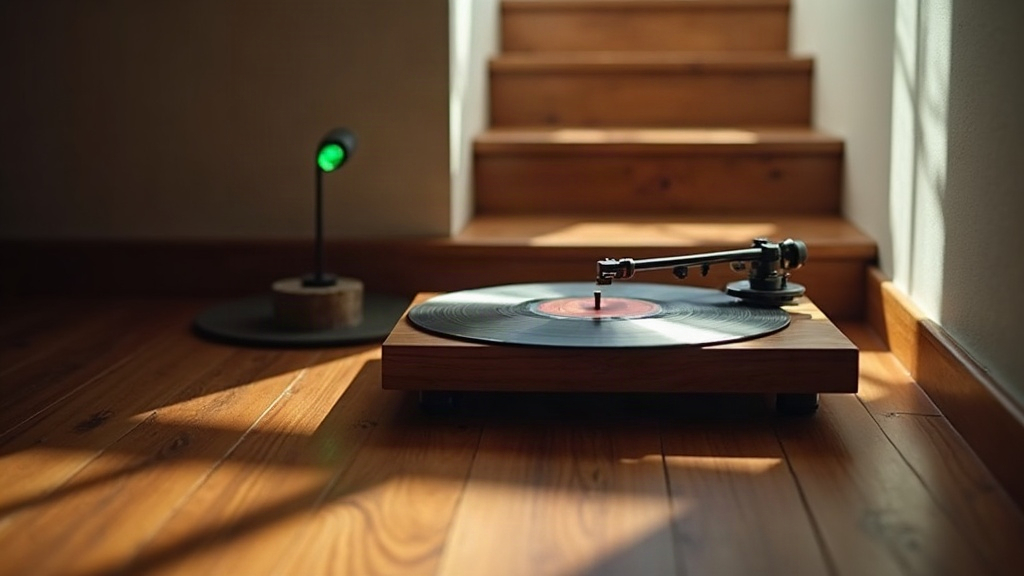
If your turntable skips, buzzes, or jumps every time someone walks across the room above or next to it, you’re dealing with footfall-induced vibration. It’s a problem that shows up constantly on suspended wooden floors upstairs, and no single gadget fixes it on its own. You need layers: decouple the turntable from the floor, add mass to soak up energy, and in stubborn cases, reinforce the floor itself. Here’s exactly how to tackle it, step by step.
Why Wooden Upstairs Floors Are a Problem
Think of a wooden joist floor as a drum skin stretched across the room. Unlike a solid concrete slab, it flexes under load and passes energy through the structure with almost no resistance. When someone takes a step:
- The impact sends a low-frequency shockwave traveling through the joists.
- That energy reaches your turntable stand and rattles the plinth.
- The stylus, sitting in a groove only microns wide, reads that movement as rumble, skipping, or a bass line that suddenly sounds smeared and muddy.
Concrete absorbs this energy fast. Suspended wood floors, especially older ones with long joist spans, do the opposite: they amplify it. That’s why the identical turntable and stand can sit rock-solid in a ground-floor room with a concrete slab, yet skip every time your kid runs down the hallway upstairs.
Step 1: Identify the Vibration Path
Before you spend a dime, figure out exactly where the vibration is entering your system:
- Tap test — gently tap the floor a few feet from the stand while a record is playing. Hear it instantly in the speakers? The floor is the main carrier.
- Walk test — have someone walk at different speeds and distances. A heavy footstep or a quick jog across the room usually triggers worse skipping than a slow, careful walk.
- Stand wobble test — press down gently on the shelf holding your turntable. Any flex or wobble there means your furniture is part of the problem too, not just the floor underneath it.
Step 2: Isolate the Turntable Itself
Add a Dedicated Isolation Platform
A proper isolation platform pairs mass with a compliant layer (springs, sorbothane pads, or air bladders) to catch vibration before it reaches the plinth. When shopping, look for:
- A rigid top plate (MDF, granite, or butcher block), at least 1 inch thick
- Isolation feet rated for your turntable’s actual weight (too stiff and they do nothing, too soft and they wobble)
- A footprint wider than the turntable’s base, for stability
Use Isolation Feet or Pucks
Can’t fit a full platform into the budget right now? Swap the stock rubber feet for dedicated isolation feet, sorbothane hemispheres or spring-based pucks work well. Stock feet are mostly there to stop the turntable from sliding around, not to isolate anything. Dedicated feet decouple high-frequency vibration far more effectively.
Step 3: Stabilize the Furniture
A shelf that flexes or a stand that wobbles will cancel out any isolation gear you’ve bought. Prioritize:
- Wall-mounted shelves over floor-standing furniture. Walls simply carry far less footfall energy than floors do.
- Heavy, rigid stands with braced legs, not thin particleboard units that flex under their own weight.
- Spiked or wide-contact feet on the stand itself, to cut down on rocking.
Wall mounting is often the single biggest upgrade you can make in an upstairs room, since it takes the floor almost entirely out of the vibration path.
Step 4: Address the Floor Structure
If isolation gear alone isn’t cutting it:
- Add mass loading under the stand. A heavy paving slab, a slab of marble, or even a sandbag platform raises the energy threshold needed to move the whole setup.
- Reinforce the joists if you’re already renovating. Adding blocking between joists cuts down on floor “bounce” significantly.
- Rearrange the room so the turntable sits away from the main walking path, and ideally not directly over an unsupported joist span.
Step 5: Combine Layers for Best Results
The setups that actually hold up long-term stack several fixes together rather than betting everything on one:
- Wall-mounted or very rigid stand
- Isolation platform with spring or sorbothane feet
- Mass-loaded base (slab or dense board)
- Turntable positioned away from the main walking path
Each layer strips away a chunk of the transmitted energy. Stack three or four of them and even aggressive, running-across-the-room footfall usually stops causing skips.
Quick Checklist
- ✅ Test to confirm whether it’s the floor or the furniture vibrating
- ✅ Upgrade to isolation feet or a platform
- ✅ Switch to a rigid, braced, or wall-mounted stand
- ✅ Add mass loading under the turntable
- ✅ Reposition away from high-traffic floor areas
Conclusion
Footstep interference on an upstairs wooden floor is a structural vibration issue, not a flaw in your turntable, and it’s entirely fixable with the right mix of isolation, mass, and smart placement. Start cheap: isolation feet and a quick repositioning often solve most of it. If skipping persists, add a wall-mounted shelf or a proper isolation platform next. Layer enough of these fixes and you’ll get skip-free vinyl playback even in a floor that bounces every time someone walks by.